
 Français
 Español
 日本語
 العربية
 繁体中文
 简体中文

Why Future Vehicle Certification Will Be Continuous Instead of One-Time Approval
Why Future Vehicle Certification Will Be Continuous Instead of One-Time Approval
Passing certification doesn't mean staying compliant.
That statement would have sounded strange ten years ago.
Today, it's becoming one of the most important realities in the automotive industry.
For decades, vehicle certification followed a simple model.
Design the product.
Complete testing.
Receive approval.
Start production.
Once the vehicle entered the market, certification was largely considered finished.
That model is disappearing.
The rise of Software-Defined Vehicles (SDVs), OTA software updates, cybersecurity regulations, cloud connectivity, and AI-powered vehicle functions means that compliance is no longer a one-time event.
It has become a continuous engineering process.
The companies that recognize this shift early will reduce risk, shorten development cycles, and avoid costly surprises after SOP.
Vehicles No Longer Stay the Same
The biggest reason certification is changing is simple.
Vehicles no longer remain unchanged after production.
Modern vehicles continuously evolve through:
OTA software updates
New cybersecurity patches
Cloud service upgrades
Connected vehicle features
AI algorithm improvements
Smartphone ecosystem updates
Navigation and infotainment enhancements
The vehicle a customer drives three years after purchase may operate very differently from the one originally certified.
That changes the meaning of compliance.
Certification Is Becoming a Lifecycle Activity
Many engineers still think of certification as a project.
Increasingly, it is becoming a lifecycle management process.
A typical vehicle program may look like this:
Year 1
Vehicle type approval completed.
Year 2
OTA introduces new infotainment features.
Year 3
Cybersecurity vulnerabilities require software updates.
Year 4
Android Auto and Apple CarPlay compatibility is enhanced.
Year 5
Cloud services are optimized.
Year 6
AI functions receive performance improvements.
Each change raises an important question:
Does this affect regulatory compliance?
Increasingly, the answer is yes.
OTA Has Changed Everything
No technology has transformed certification more than OTA (Over-the-Air) updates.
Previously, changing vehicle software required workshop visits.
Today, manufacturers can modify critical vehicle functions remotely.
OTA may influence:
Wireless communication
Infotainment behavior
Connectivity
Emergency communication
Security mechanisms
User interfaces
Software configuration
While the hardware remains unchanged, the vehicle itself continues evolving.
Certification must evolve with it.
Cybersecurity Is Never Finished
Regulations such as UN R155 and EN 18031 demonstrate another major industry change.
Cybersecurity is no longer validated once and forgotten.
New vulnerabilities appear continuously.
Threats evolve.
Attack methods change.
Manufacturers must:
Monitor security risks.
Release patches.
Update software.
Document changes.
Maintain traceability.
Compliance therefore becomes an ongoing responsibility rather than a final milestone.
Cloud Connectivity Extends the Compliance Boundary
Connected vehicles no longer operate independently.
Many functions depend on:
Cloud platforms
Remote servers
Digital services
Online authentication
Data synchronization
If cloud software changes, vehicle behavior may also change.
This means compliance increasingly extends beyond the vehicle itself.
Manufacturers must evaluate how backend systems interact with certified vehicle functions.
AI Is Introducing a New Compliance Challenge
Artificial Intelligence is becoming part of:
Driver assistance
Voice recognition
Predictive maintenance
Energy management
Smart cockpit systems
Unlike traditional software, AI models may improve over time through new training data and algorithm updates.
This creates an important question.
If AI behavior changes after deployment, how should manufacturers evaluate ongoing compliance?
This is one of the biggest discussions currently shaping the future of automotive regulation.
Why Documentation Matters More Than Ever
Continuous compliance depends on more than testing.
It also depends on documentation.
Manufacturers increasingly need complete records of:
Software versions
Configuration management
OTA history
Risk assessments
Change logs
Validation reports
Cybersecurity evidence
Without clear traceability, demonstrating compliance becomes extremely difficult.
The future belongs to companies that can prove what changed, when it changed, and how it was validated.
Continuous Compliance Requires Cross-Functional Teams
Future certification is no longer the responsibility of one department.
Successful organizations connect:
Software engineering
Cybersecurity
RF engineering
Compliance
Quality assurance
System architecture
Cloud engineering
Every software release should include a compliance impact assessment before deployment.
The earlier these teams collaborate, the fewer surprises appear later.
The Cost of Treating Certification as a One-Time Event
Many companies still budget for certification only during product development.
The larger costs often arise after production.
Unexpected software changes may require:
Additional validation
Repeat testing
Documentation updates
Engineering redesign
Delayed software releases
Extended OEM approval cycles
For global automotive platforms, these activities can easily add tens of thousands—or even hundreds of thousands of U.S. dollars in engineering costs over the vehicle's lifetime.
Continuous compliance is no longer an extra expense.
It is a strategy for reducing long-term cost and risk.
How Leading OEMs Are Preparing
Forward-looking manufacturers are already shifting their approach.
Instead of asking:
"Has this vehicle passed certification?"
They ask:
Can we maintain compliance after every OTA update?
Can we trace every software change?
Can we evaluate cybersecurity risks continuously?
Can we prove regulatory compliance throughout the product lifecycle?
This represents a fundamental change in mindset.
Certification is becoming part of product lifecycle management—not the final step before SOP.
Final Thoughts
The automotive industry is entering a new era.
As Software-Defined Vehicles, OTA, cloud connectivity, AI, and cybersecurity continue to reshape vehicle development, certification can no longer be viewed as a one-time approval.
The future belongs to Continuous Compliance.
Manufacturers that build compliance into the entire software lifecycle will reduce engineering risk, accelerate global market access, and adapt more quickly to changing regulations.
At BlueAsia, we help OEMs and Tier 1 suppliers develop long-term compliance strategies covering OTA, software lifecycle management, UN R155, UN R156, EN 18031, CE RED, Android Auto, CarPlay, NG eCall, DAB+, and global automotive certification.
Because in the era of Software-Defined Vehicles, the real challenge isn't passing certification once—it's staying compliant every day.
 Blog
Why Two-Wheelers Are Becoming As Complex As Passenger Cars
Read article
 Blog
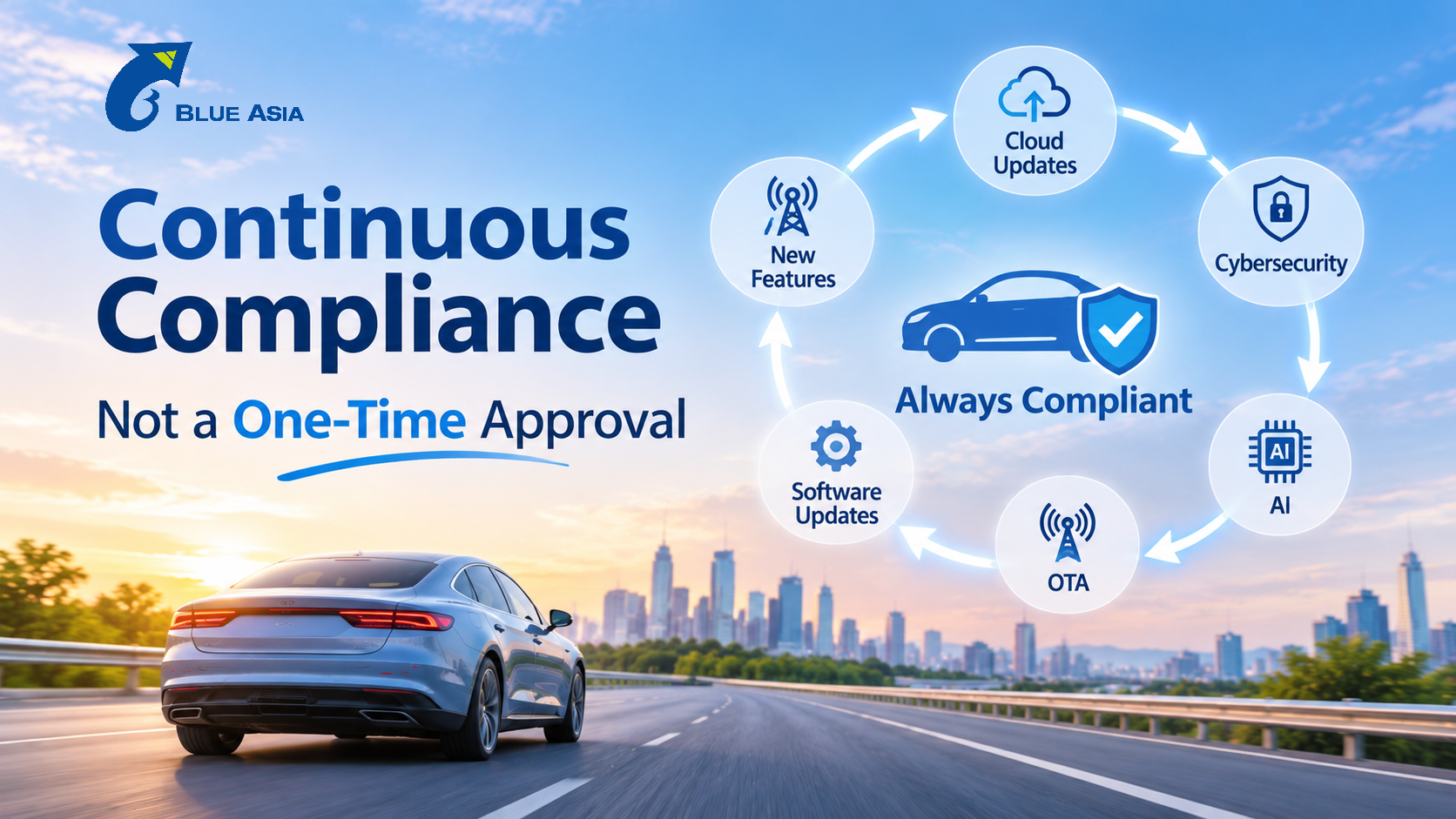
Why Future Vehicle Certification Will Be Continuous Instead of One-Time Approval
Read article
 Blog
Saudi SASO 2944 for Light Vehicles: How to Separate CST Module RF Approval from Vehicle-Leve
Read article
 Blog
Adding 4G/5G eCall to an Existing Vehicle? The Hard Part Is Not the Cellular Module.
Read article
 Blog
Apple CarPlay Audio Integration: How to Avoid Playback and Call Interference
Read article
 Blog
DAB+ Receiver Validation: How to Manage Service Following and Station Information
Read article

 4000259520