
 Français
 Español
 日本語
 العربية
 繁体中文
 简体中文


Why Passing Android Auto Doesn't Mean Your Connectivity System Is Ready
Why Passing Android Auto Doesn't Mean Your Connectivity System Is Ready
Android Auto passed.
Customers still complained.
Why?
This is a situation many Tier 1 suppliers, automotive electronics manufacturers, and OEM engineering teams have experienced.
The Android Auto certification project is complete.
Google approves the implementation.
The product enters production.
Then customer feedback starts arriving:
"The connection drops while driving."
"It reconnects too slowly."
"Audio occasionally cuts out."
"Wireless Android Auto isn't as stable as our competitors."
The first reaction is often:
"There must be a problem with Android Auto."
But after supporting many automotive connectivity projects, we've found something different.
In most cases, Android Auto isn't the root cause.
The real issue is the vehicle's wireless connectivity system.
Android Auto simply becomes the first application to expose weaknesses that already exist.
Android Auto Is an Application. Connectivity Is the Infrastructure.
One of the biggest misunderstandings in automotive development is treating Android Auto as an isolated software feature.
It isn't.
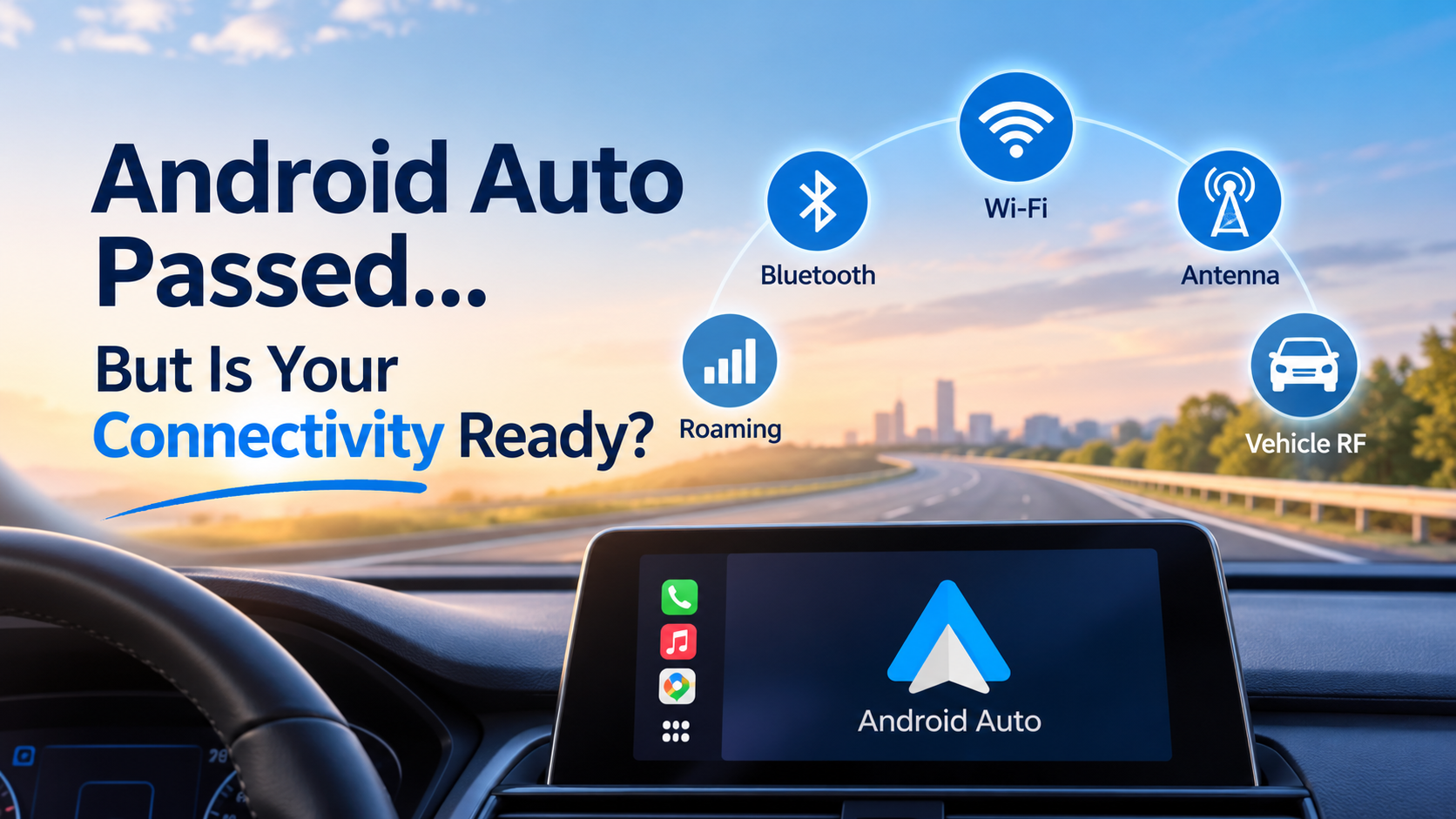
Wireless Android Auto depends on multiple technologies working together simultaneously, including:
Bluetooth
Wi-Fi Direct
5 GHz RF
Vehicle antennas
RF coexistence
Network management
Vehicle power management
Software coordination
If any of these systems becomes unstable, Android Auto is often the first function customers notice.
The software is only the visible layer.
The real challenge lies underneath.
Why Customers Experience Problems Even After Certification
Passing Android Auto certification proves that your implementation satisfies Google's functional requirements.
It does not guarantee that the vehicle will perform perfectly in every real-world environment.
Real vehicles operate under conditions that are impossible to reproduce completely in a laboratory.
For example:
Multiple wireless devices inside the vehicle
Urban RF congestion
Underground parking garages
High-speed highway driving
Different smartphone models
Various carrier networks
OTA software updates
These factors continuously influence the wireless ecosystem.
Certification confirms capability.
Customers experience reliability.
Those are two different measurements.
The Five Hidden Causes Behind Most Connectivity Complaints
1. Wi-Fi Performance
Wireless Android Auto transfers navigation, audio, voice, and display data through Wi-Fi Direct.
Small RF weaknesses may result in:
Slow startup
Video latency
Audio interruptions
Random disconnections
The Android Auto software is functioning correctly.
The wireless channel is not.
2. Bluetooth Stability
Bluetooth handles discovery, pairing, authentication, and initial communication.
If Bluetooth becomes unstable:
Android Auto may reconnect repeatedly.
Phone detection becomes inconsistent.
Initial pairing fails.
User experience deteriorates.
Many companies investigate application logs first.
The actual problem is often the Bluetooth subsystem.
3. Antenna Integration
Antenna performance changes dramatically once installed inside a vehicle.
Nearby components such as:
Display assemblies
Metal dashboards
Wireless chargers
Cellular antennas
GNSS antennas
Camera modules
can reduce antenna efficiency or increase interference.
A product may pass laboratory testing but behave differently after full vehicle integration.
This is one of the most common causes of field complaints.
4. RF Coexistence
Modern vehicles simultaneously operate:
Bluetooth
Wi-Fi
Cellular
GNSS
UWB
NFC
These radios share spectrum, processors, antennas, and power resources.
Without proper coexistence management:
Wi-Fi performance decreases.
Bluetooth becomes unstable.
Audio quality suffers.
Connection reliability drops.
Android Auto simply reveals the interaction between these systems.
5. Roaming and Real-World Mobility
Laboratory testing often assumes stable wireless conditions.
Vehicles do not.
As the vehicle moves through different environments, the wireless system constantly adapts.
Changing signal conditions, interference, and temporary communication interruptions all challenge system stability.
A connectivity platform that performs well in static testing may struggle during daily driving.
This is why road validation remains essential.
Connectivity Has Become a System Engineering Challenge
Ten years ago, engineers could optimize each wireless technology separately.
Today, that's no longer enough.
A software update may influence RF performance.
An antenna change may affect Bluetooth stability.
A new Wi-Fi configuration may change Android Auto behavior.
Everything is connected.
The industry's challenge has shifted from optimizing individual technologies to managing the entire connectivity ecosystem.
Why Some Projects Pass Certification but Still Receive Customer Complaints
The difference is often the validation strategy.
Many projects validate:
✔ Android Auto
✔ Bluetooth
✔ Wi-Fi
✔ RF
✔ EMC
individually.
Leading automotive companies go one step further.
They validate the complete connectivity experience.
Instead of asking:
"Did Android Auto pass?"
They ask:
Does it remain stable after several OTA updates?
Does it work equally well with different smartphone brands?
Does it remain reliable in weak signal environments?
Does Bluetooth coexist correctly with Wi-Fi?
Does antenna performance remain stable after vehicle integration?
These questions better reflect what customers actually experience.
The Cost of Solving Connectivity Problems Too Late
When connectivity issues are discovered after SOP, the impact extends far beyond certification.
Manufacturers may face:
Software redevelopment
RF optimization
Antenna redesign
OTA updates
Additional validation
Customer warranty claims
Delayed vehicle programs
These engineering activities can easily cost tens of thousands—or even hundreds of thousands of U.S. dollars, significantly exceeding the original certification budget.
The most expensive connectivity problem is usually the one discovered after customers begin using the vehicle.
Build a Connectivity Strategy—Not Just an Android Auto Strategy
As vehicles become increasingly connected, manufacturers should shift their focus from individual certifications to complete wireless system validation.
A stronger development strategy includes:
✔ Early RF architecture evaluation.
✔ Wi-Fi and Bluetooth coexistence testing.
✔ Antenna validation in the complete vehicle.
✔ Multi-device interoperability testing.
✔ Road testing under real operating conditions.
✔ OTA impact assessments before software releases.
This approach significantly reduces customer complaints after production.
Final Thoughts
Passing Android Auto Certification is an important milestone—but it doesn't guarantee that your vehicle connectivity system is ready for the real world.
Customers don't judge your product based on a certification report.
They judge it based on whether the connection works every single day.
As connected vehicles continue evolving, success will depend less on passing individual certifications and more on building a reliable, integrated wireless architecture.
At BlueAsia, we help automotive manufacturers and Tier 1 suppliers evaluate Android Auto, Wi-Fi Direct, Bluetooth, RF performance, EMC, antenna systems, and global automotive compliance—helping teams identify connectivity risks before they become customer complaints.
Because in the future of connected vehicles, the real product isn't Android Auto—it's the connectivity system behind it.
 Blog
Why Smart Cockpit Projects Fail Because Of System Integration—Not Hardware
Read article
 Blog
Why Passing Android Auto Doesn't Mean Your Connectivity System Is Ready
Read article
 Blog
Can R155/R156 Evidence Be Reused Across Vehicle Categories?
Read article
 Blog
GSO 2693:2026 Is Now Here. Does Your Existing DAB+ Test Report Still Cover the New GCC Requi
Read article
 Blog
Why Software Updates Are Creating Supplier Management Challenges
Read article
 Blog
Why Certification Engineers Need to Think Like System Architects
Read article

 4000259520