
 Français
 Español
 日本語
 العربية
 繁体中文
 简体中文


BIS Mandatory ISI Mark Certification: An Overview of the Process and Requirements
1. Introduction to BIS Certification
India's Foreign Manufacturers Certification Scheme (FMCS) is administered by the Bureau of Indian Standards (BIS) under the Bureau of Indian Standards Act, 2016, and the Bureau of Indian Standards (Conformity Assessment) Regulations, 2018.
Under FMCS, foreign manufacturers can obtain a BIS licence to use the applicable Standard Mark on products manufactured outside India that comply with the relevant Indian Standards (IS).
BIS certification is mandatory for products covered by applicable Indian government Quality Control Orders (QCOs) and other mandatory certification notifications. Manufacturers must obtain the required BIS licence or registration before placing regulated products on the Indian market.
2. Basic Information About BIS Certification
The following table summarizes the basic certification information presented in the original article.
| Item | Description |
|---|---|
| Mandatory status | Mandatory for products covered by applicable requirements |
| Regulated products | Products included in the BIS mandatory certification scope |
| Factory inspection | Required under the conventional FMCS licensing process |
| Certificate validity | The original article states two years |
| Local testing | Yes, as indicated in the original article |
| Local representative | Required; an Authorized Indian Representative (AIR) must be nominated |
Note: The exact testing arrangements, inspection requirements, licence validity and local representative requirements depend on the applicable certification scheme and current BIS procedures.
3. Main Categories of BIS Certification
The original article divides BIS certification into three categories:
3.1 Mandatory ISI Mark Certification
This category involves product testing, an initial factory inspection and post-certification surveillance.
The product categories mentioned in the original article include:
Cement
Food products
Certain automotive products
Steel products
Under this certification route, manufacturers must demonstrate conformity with the relevant Indian Standards and meet the applicable licensing and marking requirements.
3.2 Compulsory Registration Scheme (CRS)
The Compulsory Registration Scheme (CRS) applies to notified electronics and information technology products.
The original article lists the following examples:
Tablets
Microwave ovens
Wireless keyboards
Power adaptors for printers
LED lamps
Lithium batteries
Power banks
Mobile phones
Smart card readers
Uninterruptible Power Supplies (UPS) and inverters rated up to 10 kVA
Rear-projection, LCD and LED televisions with screen sizes of 32 inches or below
The applicable product categories and technical requirements must be checked against the latest CRS notifications.
3.3 Voluntary BIS Certification
Products that are not covered by mandatory certification or compulsory registration requirements may apply for BIS voluntary certification, subject to the relevant scheme and applicable Indian Standards.
4. Scope of Products Covered by BIS Certification
According to the original article, BIS had issued more than 30,000 product certification licences, allowing manufacturers to apply the ISI Standard Mark to certified products.
The certification scope covers a wide range of industrial sectors, including:
Agricultural products
Textiles
Electrical and electronic products
Automotive components
Steel and construction materials
Household appliances
Food-related products
Whether certification is mandatory depends on the applicable Indian Standard and the relevant government notification or Quality Control Order.
5. Products Subject to Mandatory BIS Certification
The original article identifies two main groups of products subject to mandatory BIS requirements.
5.1 First Group: Products Under Mandatory ISI Certification
The first group covers product categories that have been subject to mandatory certification in phases since 1986. The original article lists the following:
Tyres
Electric irons, electric kettles, electric stoves, heaters and other household appliances
Cement and concrete
Circuit breakers
Steel products
Electricity meters
Automotive components
Food products and milk powder
Feeding bottles
Tungsten filament lamps
Oil pressure stoves
Large-scale [product name unclear in the Chinese source]
Plugs
Medium- and high-voltage wires and cables
Self-ballasted lamps
5.2 Second Group: Electronics and Information Technology Products Under CRS
The second group consists of electronic and information technology products covered by compulsory registration requirements, which the original article states became mandatory from March 2013.
The listed products include:
Set-top boxes
Portable computers
Laptops
Tablets
Monitors with screen sizes of 32 inches or above
Video monitors
Printers, plotters and scanners
Wireless keyboards
Telephone answering machines
Automatic data processing machines
Microwave ovens
Projectors
Electronic clocks powered by mains electricity
Power amplifiers
Electronic musical systems
5.3 Additional Products Added to the Mandatory Registration List
The original article states that the following products were added to the compulsory registration scope from November 2014:
Power adaptors for IT equipment
Power adaptors for [product category unclear in the Chinese source]
Uninterruptible Power Supplies (UPS)
DC or AC LED modules
Batteries
Self-ballasted LED lamps
LED luminaires
Mobile phones
Cash registers
Point-of-sale (POS) terminals
Photocopiers
Smart card readers and writers
Postal processing machines and automatic stamping machines
Passport readers
Power banks
Regulatory note: The above lists reproduce the product categories and historical implementation dates provided in the original article. They should not be treated as a complete or current list of products subject to mandatory BIS certification. The applicable requirements and product coverage must be verified against the latest BIS notifications.
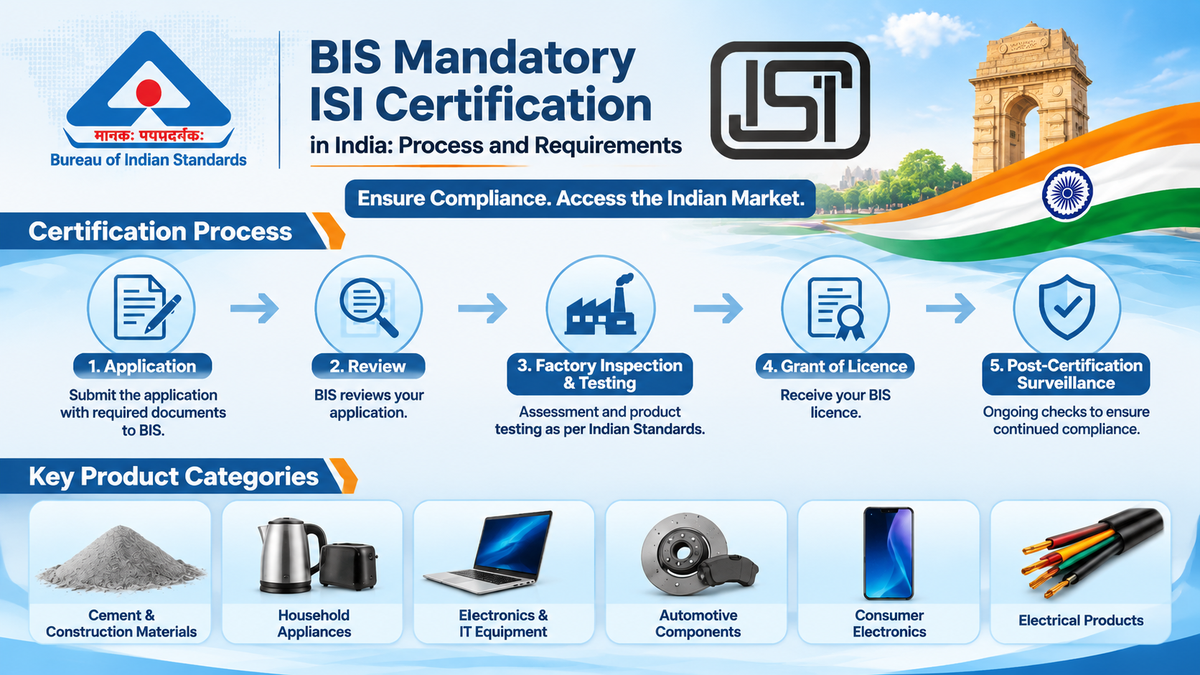
6. BIS Mandatory ISI Mark Certification Process
The following section describes the certification procedure presented in the original article.
6.1 Application Submission
The applicant must complete the prescribed application form and submit it together with the applicable application fee.
The original article identifies the following supporting documents:
Factory location details and factory layout plan.
Documents demonstrating the legal status or ownership of the manufacturing premises.
A list of existing production and testing equipment.
Details of the testing and inspection scheme currently in use or proposed for implementation, together with an undertaking to comply with the BIS-approved Scheme of Inspection and Testing (SIT) after the licence is granted.
An undertaking to pay the prescribed marking fee from the date of licence grant.
An undertaking to comply with all conditions of the licence and immediately discontinue the use of the Standard Mark if the licence is suspended or cancelled.
A process flow chart describing the manufacturing and inspection procedures.
Details of the technical personnel currently employed by the manufacturer.
6.2 Application Review and Recording
BIS reviews the submitted application and supporting documents.
If the application is complete and meets the procedural requirements, BIS records the application and assigns an application number. The application is then formally registered for further processing.
6.3 Initial Factory Inspection and Product Testing
The applicant arranges an inspection date with BIS.
During the initial factory inspection, BIS inspection officials assess the manufacturer's production capabilities, quality control procedures, manufacturing equipment and personnel competence.
Samples may also be collected for testing to verify conformity with the applicable Indian Standards.
Depending on the applicable arrangements, testing may be conducted at the manufacturing facility, a BIS laboratory or another BIS-recognized laboratory.
During the inspection, BIS officials also discuss the Scheme of Inspection and Testing (SIT) with the applicant's management. The scheme specifies the production controls and routine testing activities that the manufacturer must implement after certification.
6.4 Grant of BIS Licence
A BIS licence may be granted once the initial inspection and product testing results satisfy the applicable requirements.
The original article states that the certificate is initially valid for one year and may be extended by two years upon application, provided the licence holder has complied with the relevant conditions.
If a manufacturer wishes to add product varieties covered by the same Indian Standard to an existing licence, the scope may be amended subject to the applicable testing and approval requirements.
Upon expiry, the licence may be renewed, subject to the applicable BIS renewal procedures and the manufacturer's compliance record.
6.5 Post-Certification Surveillance
After the licence is granted, the manufacturer must continue to comply with the applicable Scheme of Inspection and Testing and ensure that certified products remain consistent with the relevant Indian Standards.
The manufacturer must maintain appropriate production and testing records and pay the prescribed marking fees.
BIS may conduct periodic surveillance inspections to assess:
Compliance with the approved Scheme of Inspection and Testing.
Implementation of the manufacturer's quality control system.
Consistency of production with the applicable technical standards.
Product conformity through sample testing.
Samples collected during surveillance may be sent to BIS laboratories or independent laboratories for further testing.
BIS communicates the inspection and testing results to the licence holder through the applicable procedures.
If non-conformities are identified, BIS may take appropriate enforcement action, including suspension of the use of the Standard Mark or cancellation of the licence, depending on the nature and severity of the non-compliance.
Manufacturers must therefore maintain effective production controls and ensure continued conformity throughout the validity of their BIS licences.
 Blog
Is DOT Certification Mandatory in the United States? Requirements and Compliance Process
Read article
 Blog
BIS Mandatory ISI Mark Certification: An Overview of the Process and Requirements
Read article
 Blog
GB 36672-2026: What Electric Motorcycle Battery Manufacturers Need to Prepare Before July 20
Read article
 Blog
UL Certification: Process, Product Categories and Certificate Validity
Read article
Blog
Your Automotive Component Is Already Approved. Can You Change the PCB, Antenna or Supplier W
Read article
 Certification Guides
CE RED Certification Guide: Requirements, Process and Timeline
Read article

 4000259520