
 Français
 Español
 日本語
 العربية
 繁体中文
 简体中文


Does CE RED Replace EMC Testing? Understanding the Relationship Between Radio and EMC Requirements
Contact:
Email: [email protected]
WhatsApp: +86 17663606879
Does CE RED Replace EMC Testing? Understanding the Relationship Between Radio and EMC Requirements
When preparing a wireless product for the European market, many manufacturers focus heavily on RF testing.
But is RF performance enough to demonstrate compliance with the Radio Equipment Directive (RED)?
For manufacturers of wireless modules, IoT devices, automotive electronics and connected products, understanding the relationship between RED and electromagnetic compatibility is essential for effective compliance planning.
1. Understanding the Radio Equipment Directive
Directive 2014/53/EU, commonly known as the Radio Equipment Directive (RED), establishes the regulatory framework for placing radio equipment on the EU market.
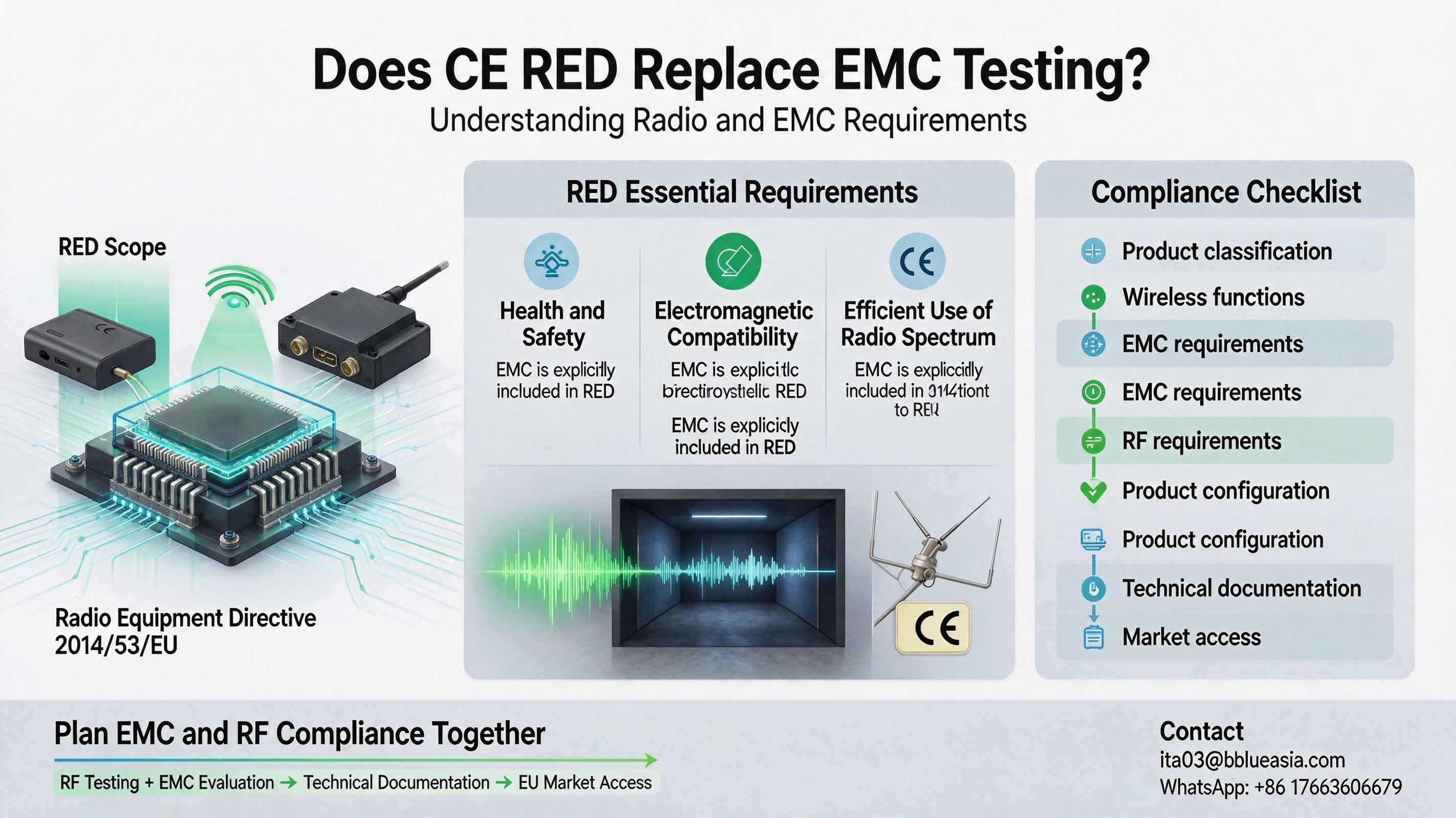
According to the European Commission, RED addresses three key areas of essential requirements:
Health and safety.
Electromagnetic compatibility.
Effective use of radio spectrum and avoidance of harmful interference.
RED became applicable on 13 June 2016.
This means that manufacturers should not approach RED compliance as an RF-only exercise.
2. Why Is EMC Included in RED?
One important provision is Article 3(1)(b).
It requires radio equipment to be constructed to ensure an adequate level of electromagnetic compatibility, as set out in Directive 2014/30/EU.
This provision highlights the relationship between radio equipment compliance and EMC.
In practical terms, manufacturers need to consider how their products behave in an electromagnetic environment.
For example, development teams may need to evaluate:
Whether the equipment generates unacceptable electromagnetic disturbances.
Whether the equipment maintains its intended performance when exposed to relevant electromagnetic disturbances.
Whether the selected EMC standards are appropriate for the product category and intended use.
The applicable technical requirements and test methods must be determined according to the relevant harmonised standards and product characteristics.
3. RED Covers More Than RF Performance
Article 3 of RED contains several essential requirements.
Article 3(1)(a): Health and Safety
Radio equipment must meet the applicable health and safety protection requirements, including relevant safety objectives without the voltage limitation specified in the Low Voltage Directive.
Article 3(1)(b): Electromagnetic Compatibility
Equipment must achieve an adequate level of electromagnetic compatibility.
Article 3(2): Efficient Use of Radio Spectrum
Radio equipment must effectively use and support the efficient use of radio spectrum to avoid harmful interference.
These requirements address different aspects of product compliance and should be considered together.
4. What Has Not Automatically Changed?
Understanding the relationship between RED and EMC also means avoiding several common misunderstandings.
First, RED is not simply an RF testing requirement.
EMC is explicitly included in the essential requirements of RED.
Second, RED does not mean every wireless product requires two completely duplicated EMC assessments.
The applicable conformity assessment framework and standards must be determined according to the product and legislation.
Third, RF compliance does not automatically demonstrate EMC compliance.
Radio performance and electromagnetic compatibility address different technical aspects.
A suitable compliance plan should therefore identify the applicable requirements rather than assume that one test automatically covers everything.
5. Practical Compliance Checklist for Manufacturers
Before preparing a CE RED project, manufacturers can consider the following:
| Checkpoint | What to review | Purpose |
|---|---|---|
| Product classification | Confirm whether the product falls within RED scope | Identify applicable legislation |
| Wireless functions | Identify Wi-Fi, Bluetooth, cellular and other radio functions, where applicable | Establish the RF assessment scope |
| EMC requirements | Identify applicable EMC standards and requirements | Plan EMC evaluation |
| RF requirements | Determine applicable radio standards and frequency bands | Plan RF testing |
| Product configuration | Record hardware, antennas and software versions | Maintain test configuration consistency |
| Technical documentation | Prepare applicable technical documentation and test evidence | Support conformity assessment |
| Market access | Review the applicable conformity assessment procedure | Prepare for EU market placement |
These are practical project-management recommendations. The final assessment scope must be established according to the applicable legal requirements and harmonised standards.
6. Plan EMC and RF Compliance Together
For wireless electronics manufacturers, coordinating RF and EMC activities early can help identify potential technical issues and avoid unnecessary delays in the market access process.
Blue Asia provides third-party testing and certification services for electronic products, including EMC, RF and global market access-related services.
For manufacturers preparing wireless products for the European market, our team welcomes discussions about applicable testing requirements and certification planning.
Contact:
Email: [email protected]
WhatsApp: +86 17663606879
 Blog
Why Buses And Trucks Face Different Connectivity Challenges Than Passenger Cars
Read article
 Blog
The Future Compliance Engineer Will Need to Understand Systems—Not Standards
Read article
 Blog
Trucks and Buses Exported to the Middle East: Do eCall and DAB+ Apply the Same Way?
Read article
 Blog
Your 77 GHz Radar Passed RF Testing. Why Can the Vehicle Still Fail EMC?
Read article
 Blog
Does CE RED Replace EMC Testing? Understanding the Relationship Between Radio and EMC Requir
Read article
 Blog
Does eCall Work Only After a Crash? Understanding Automatic and Manual Trigger Testing
Read article

 4000259520