The Thailand Industrial Standards Institute (TISI) enforces mandatory certification under the Industrial Product Standards Act. Understanding the core principles below is essential to preparing compliant documentation and maintaining certification effectively.
Certification Nature:
TISI certification is divided into Mandatory and Voluntary schemes.
Common mandatory products include:
Electric fans
Washing machines
Refrigerators
Air conditioners
Power plugs and sockets
Marking Requirement:
All mandatory products must display the TISI mark, showing both the TIS standard number and certification number, to be legally sold in Thailand.
Localization Requirement:
Foreign manufacturers must appoint a company registered in Thailand as the legal representative (certificate holder) to submit the application.
Additionally, product labels and manuals must include Thai language information.
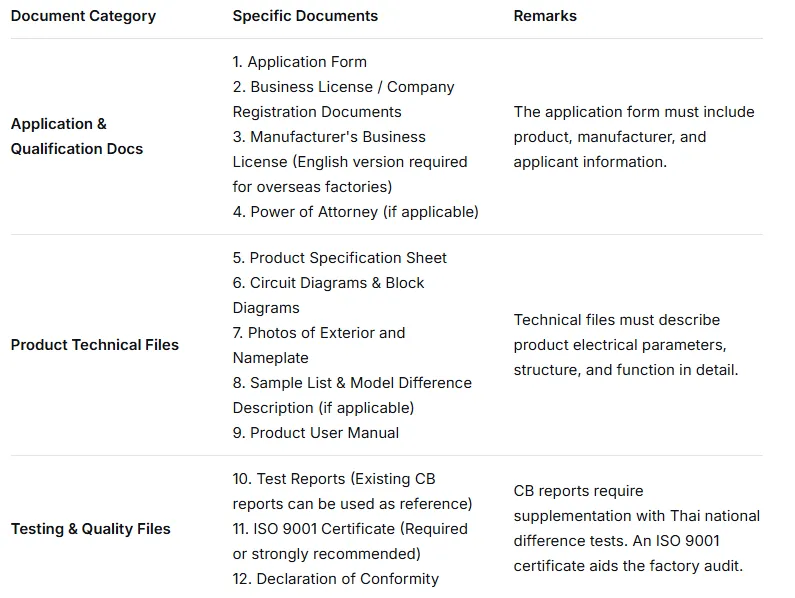
Preparing accurate and complete documentation is the first step toward a smooth certification process. Below is the comprehensive checklist of required documents for TISI application:
Document Checklist:
Application form (provided by TISI)
Product technical specifications and circuit diagrams
Product nameplate and label design
Bill of materials (BOM)
CB or IEC test reports (if available)
Product user manual (in English or Thai)
Sample products (typically 2–3 complete sets)
Local representative authorization letter
Important Notes:
Testing Requirements:
Testing must be conducted in a TISI-accredited laboratory. Testing usually takes 4–6 weeks, depending on product type.
Language Requirements:
The user manual must be in English or Thai.
The TISI mark must be clearly visible, with a minimum height of 5mm, and include the certification number, voltage specifications, and “Made in [Country]” (e.g., Made in China).
Obtaining the TISI certificate marks the beginning of compliance — maintaining it properly ensures continuous legal market access.
The TISI Certificate of Conformity is valid for 3 years and can be renewed upon expiry if all compliance conditions are met.
During the 3-year validity period, certificate holders must pass annual surveillance audits, which may include:
Factory inspections (announced or unannounced)
Market product sampling and re-testing
Failure to pass surveillance audits can result in certificate suspension or revocation.
If the product undergoes hardware changes (e.g., circuits, antennas) or software modifications (e.g., power or frequency adjustments), these changes must be reported to TISI.
Re-testing or re-certification may be required, costing approximately 30–70% of the original certification cost.
To complete TISI certification efficiently and avoid costly rework, follow these best practices:
Start Early:
The entire certification process typically takes 8–12 weeks, covering document review, product testing, and factory inspection.
Use Existing Reports:
You can leverage CB or IEC reports as supporting documents to reduce testing time, but Thai national difference testing is still mandatory.
Leverage System Certificates:
Manufacturers with ISO 9001 certification can significantly simplify factory audits and shorten approval time.
Local Representative Requirement:
Only a registered Thai company can serve as your legal representative. Without one, the certification application cannot proceed.
Non-Compliance Risks:
Selling uncertified products subject to TISI regulations may lead to:
Fines of up to 200,000 THB (~¥40,000 RMB)
Imprisonment up to 2 years
Daily penalties for misuse of the TISI mark until corrected
TISI continuously updates technical standards to align with global safety and energy efficiency goals.
As of 2025, the following key updates are in effect or coming soon:
Hot/Cold Water Dispensers & Distribution Boards — mandatory from October 1, 2025
Microwave Ovens (including combination types) — mandatory from December 30, 2025
Energy Efficiency Standard for Air Conditioners — mandatory from April 4, 2026
New Standards for products such as electric irons, washing machines, and instantaneous water heaters are expected soon
Always confirm the latest version of applicable standards before submission.
Successfully obtaining and maintaining Thailand’s TISI certification requires:
✅ Early confirmation of product category and applicable standards
✅ Accurate and complete document preparation (in Thai or English)
✅ Appointment of a qualified Thai representative
✅ Continuous monitoring of annual audits and standard updates
With these steps, manufacturers can efficiently access the Thai market while ensuring full regulatory compliance.
Q1: How long does it take to get TISI certification?
A1: Typically 8–12 weeks, depending on testing time, product complexity, and factory audit schedules.
Q2: Can foreign manufacturers apply directly?
A2: No. A Thai-registered company must act as the local certificate holder and handle the application.
Q3: Can existing CB reports be used for TISI certification?
A3: Yes, they can help reduce testing workload but must include Thailand’s specific national differences.
Q4: What if my certificate expires?
A4: You can renew your TISI certificate before its expiration date, provided all surveillance audits are passed.
Q5: What are the consequences of selling uncertified products?
A5: Violations can result in product seizure, fines up to 200,000 THB, or imprisonment for up to two years.
BLUEASIA Certification Consulting
Professional ASEAN certification consulting, covering TISI, SIRIM, SNI, and IMDA compliance.
Email: king.guo@cblueasia.com
Phone: +86 13534225140
Related News