
 Français
 Español
 日本語
 العربية
 繁体中文
 简体中文


From 2G/3G to 4G/5G: What EU eCall Regulation 2024/1180 Means for Manufacturers
Contact: Olivia
Email: [email protected]
Whatsapp:+86 17663606879
As European mobile network operators gradually phase out 2G and 3G networks, how can vehicle manufacturers ensure that their eCall systems remain compatible with evolving communication technologies?
For automotive OEMs, Tier 1 suppliers and eCall system developers, the transition involves more than a change in network technology. It also requires attention to updated technical standards and type-approval timelines.
1. Regulatory Background
Commission Delegated Regulation (EU) 2024/1180, adopted on 14 February 2024 and published in the Official Journal on 19 April 2024, amends Regulation (EU) 2015/758 concerning the standards relating to the 112-based eCall in-vehicle system.
The regulation entered into force on 9 May 2024.
One of its key objectives is to update the standards framework to address eCall operation over packet-switched communication networks, including 4G and 5G technologies.
2. What Has Changed?
The regulation updates the references to several European standards and technical specifications.
The key references include:
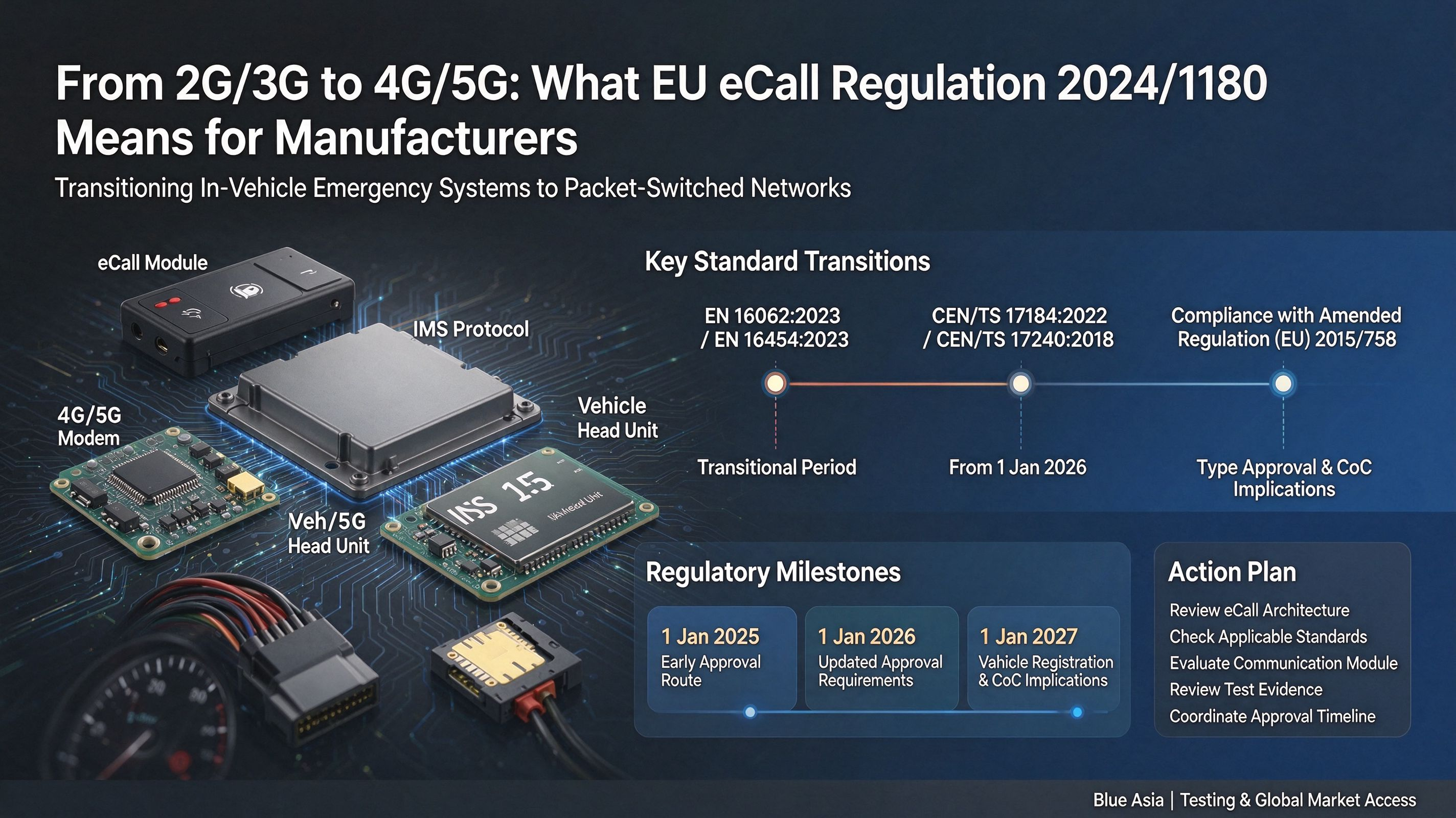
EN 16072:2022
Pan-European eCall operating requirements.
EN 16062:2023
eCall High Level Application Requirements (HLAP), applicable during the transitional period from 9 May 2024 to 31 December 2025.
CEN/TS 17184:2022
eCall high-level application protocols using IP Multimedia Subsystem (IMS) over packet-switched networks, applicable from 1 January 2026.
EN 16454:2023
eCall end-to-end conformance testing, applicable during the transitional period from 9 May 2024 to 31 December 2025.
CEN/TS 17240:2018
eCall end-to-end conformance testing for IMS packet-switched systems, applicable from 1 January 2026.
EN 15722:2020
eCall Minimum Set of Data (MSD).
3. Three Important Regulatory Milestones
Automotive manufacturers should pay particular attention to the following dates.
1 January 2025 – Early Approval Route
Where a manufacturer requests it, national authorities must not refuse new type approvals or extensions of existing approvals for vehicles, systems, components or separate technical units that comply with CEN/TS 17184:2022 and CEN/TS 17240:2018.
1 January 2026 – Updated Approval Requirements
National authorities must refuse new type approvals or extensions of existing approvals for vehicles, systems, components or separate technical units that do not comply with Regulation (EU) 2015/758 as amended by Regulation (EU) 2024/1180.
1 January 2027 – Vehicle Registration and Conformity Implications
For relevant new vehicles approved after 31 March 2018 under Regulation (EU) 2015/758, certificates of conformity will no longer be considered valid for the purposes of Article 48(1) of Regulation (EU) 2018/858 if the vehicles do not comply with the packet-switched eCall technical specifications.
This has direct implications for manufacturers managing vehicle approval and market introduction schedules.
4. What Has Not Automatically Changed?
The regulation should not be interpreted as an immediate cancellation of all existing eCall approvals or as a requirement for every vehicle already on the road to be retrofitted.
Its transitional provisions specifically address new type approvals, extensions of existing approvals and the validity of certificates of conformity for relevant new vehicles.
The actual impact should therefore be assessed according to the vehicle category, approval status, system configuration and applicable transition provisions.
5. Practical Action Plan for Automotive Manufacturers
To prepare for the transition, project teams should consider the following actions:
Review the Current eCall Architecture
Identify whether the system relies on circuit-switched 2G/3G communication or supports packet-switched networks.
Review Applicable Standards
Check the standards referenced in the current approval documentation and identify the applicable transition dates.
Evaluate the Communication Module
Review the modem, network support and relevant software configuration against the intended eCall architecture.
Review Existing Test Evidence
Determine whether existing test reports and approval documentation remain applicable to the updated technical requirements.
Coordinate the Approval Timeline
Align engineering validation, type-approval planning and vehicle production schedules with the relevant 2026 and 2027 milestones.
6. Supporting Automotive Compliance Projects
The transition from traditional mobile networks to packet-switched communication creates important planning considerations for automotive manufacturers and suppliers.
At Blue Asia, we provide electronic testing and global certification support, including automotive electronics, EMC, RF and related market access services.
For manufacturers developing connected vehicle systems and automotive electronic products, early coordination of testing and certification requirements can support a more structured market access process.
If your team is preparing an eCall-related project or reviewing automotive compliance requirements, feel free to contact us to discuss your needs.
Need Assistance with Automotive Compliance and Global Market Access?
If your team is preparing an eCall project or evaluating automotive electronic compliance requirements, feel free to contact us to discuss potential testing and certification support.
Olivia | Blue Asia
Email: [email protected]
WhatsApp: +86 176 6360 6879
Let's stay connected and explore potential cooperation!
Blue Asia | Testing & Global Market Access
 Blog
Why Multi-Market Vehicle Development Is Replacing Single-Market Design
Read article
 Blog
The Biggest DAB+ Problem Isn't Reception. It's Platform Architecture
Read article
 Blog
Saudi SASO 2944 Mandatory Date Delayed to 2028: What Evidence Must eCall Manufacturers Still
Read article
 Blog
Your Motorcycle Has Bluetooth, Wi-Fi and a Connected Display. Is It Ready for UN R155?
Read article
 Blog
Bluetooth BQB: What Product Teams Should Clarify at Project Start
Read article
 Blog
From 2G/3G to 4G/5G: What EU eCall Regulation 2024/1180 Means for Manufacturers
Read article

 4000259520