
 Français
 Español
 日本語
 العربية
 繁体中文
 简体中文


The Biggest DAB+ Problem Isn't Reception. It's Platform Architecture
The Biggest DAB+ Problem Isn't Reception. It's Platform Architecture
Everyone tries to improve RF.
Very few improve the platform architecture.
That's why many DAB+ projects still struggle—even after the receiver performs well in the lab.
Ask an automotive engineer what causes most DAB+ failures, and you'll probably hear answers like:
"Receiver sensitivity isn't good enough."
"The antenna needs tuning."
"There's too much RF interference."
Those factors certainly matter.
But after supporting vehicle radio and automotive infotainment projects, we've found that they are rarely the real reason why programs are delayed.
The biggest challenge today isn't reception.
It's platform architecture.
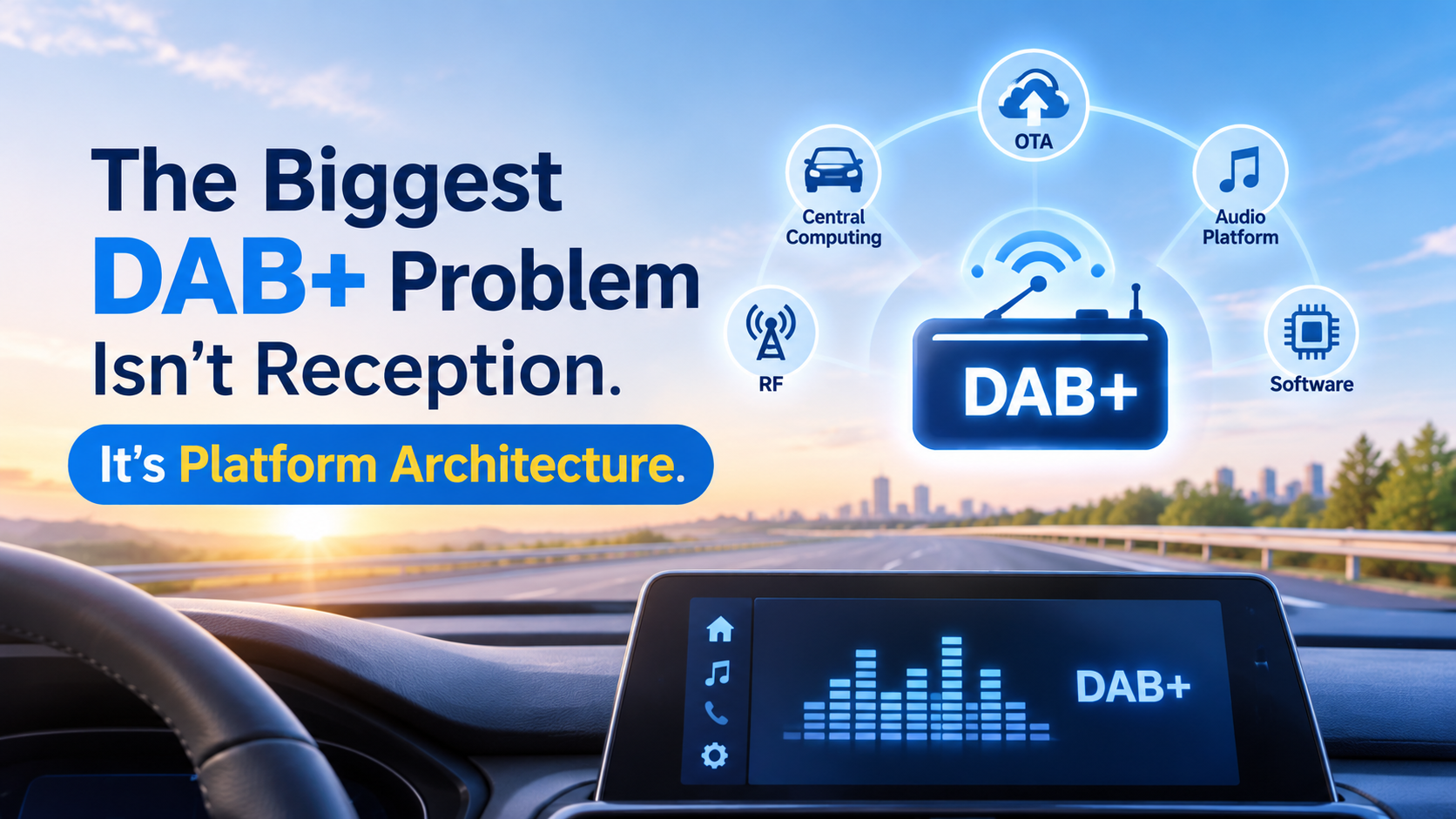
As vehicles evolve into Software-Defined Vehicles (SDVs), DAB+ is no longer an isolated radio function. It has become part of a connected software ecosystem that includes central computing, OTA updates, digital cockpits, cloud services, and multiple wireless technologies.
That changes the way manufacturers should think about DAB+ certification.
DAB+ Is No Longer Just a Radio Receiver
Ten years ago, a DAB+ receiver was relatively self-contained.
If the RF performance was good and the antenna was properly designed, the project usually progressed smoothly.
Today's infotainment platforms are very different.
A single vehicle may integrate:
DAB+
Bluetooth
Wi-Fi
Cellular
GNSS
Apple CarPlay
Android Auto
Voice assistants
Cloud services
OTA software updates
All of these functions share processing resources, software frameworks, antennas, power management, and communication buses.
DAB+ is no longer operating alone.
It is part of a much larger system.
Why RF Performance Alone No Longer Guarantees Success
Many engineering teams continue to optimize RF performance first.
That is important—but no longer sufficient.
A receiver can achieve excellent laboratory results while the complete vehicle still delivers poor customer experience.
Why?
Because DAB+ performance increasingly depends on the entire platform.
For example:
Audio switching may be controlled by the operating system.
Signal processing may share CPU resources with navigation.
OTA updates may change software behavior.
Wireless coexistence may introduce new interference.
Power management may affect receiver stability.
None of these problems originate from the RF chipset.
They originate from the architecture surrounding it.
Five Platform Factors That Now Influence DAB+
1. Audio Platform Integration
Modern infotainment systems combine multiple audio sources:
DAB+
FM
Bluetooth Audio
USB Media
Online Streaming
Voice Navigation
The audio platform decides how these services interact.
Poor software design can lead to:
Audio interruptions
Slow source switching
Volume inconsistencies
Delayed playback
The radio hardware performs correctly.
The user experience does not.
2. Central Computing
Many OEMs are replacing dozens of independent ECUs with Central Computing or Domain Controllers.
This improves vehicle flexibility but also creates new engineering challenges.
The DAB+ receiver may now depend on shared processors and operating systems.
If computing resources become overloaded, radio performance may suffer even though the RF subsystem is functioning normally.
The bottleneck has moved from hardware to system resources.
3. OTA Software Updates
Software updates have become routine in modern vehicles.
However, even a small OTA release may unintentionally affect:
Audio routing
Service Following
Station lists
User interface behavior
Background services
The DAB+ hardware remains unchanged.
The customer still notices a different radio experience.
This is why OTA validation is becoming part of DAB+ compliance planning.
4. Software Architecture
Today's vehicle radio relies heavily on software.
Features such as:
Service Following
Service Linking
Dynamic Label
Slideshow
Announcement Switching
Regional Frequency Management
are software-driven.
As software complexity increases, validation becomes more important than individual feature testing.
A well-designed software architecture is now just as valuable as a high-performance RF front end.
5. RF Coexistence
Modern vehicles operate multiple wireless technologies simultaneously.
These include:
Bluetooth
Wi-Fi
Cellular
GNSS
UWB
NFC
Without proper coexistence management, RF noise generated by one subsystem can reduce DAB+ reception quality.
Improving receiver sensitivity alone cannot solve a coexistence problem.
The entire wireless ecosystem must be evaluated.
Why SDVs Are Changing DAB+ Validation
The rise of the Software-Defined Vehicle (SDV) is transforming automotive engineering.
Instead of validating individual ECUs, manufacturers increasingly validate complete software platforms.
That means DAB+ can no longer be treated as an isolated certification activity.
It must be considered alongside:
System software
Connectivity
Cybersecurity
OTA updates
Vehicle architecture
Cloud integration
Certification is evolving from component testing to system validation.
Why Some Projects Pass the Lab but Struggle on the Road
This is one of the most common questions customers ask.
"Why did our receiver pass testing but perform poorly during vehicle validation?"
The answer is usually straightforward.
Laboratory testing validates a controlled environment.
Real vehicles operate in a dynamic one.
Road performance depends on:
Software scheduling
CPU workload
RF coexistence
Antenna placement
Vehicle architecture
Network interaction
The receiver is only one piece of a much larger puzzle.
The Cost of Ignoring Platform Architecture
Many companies still budget only for laboratory testing.
The real costs often appear later.
Late architectural issues may require:
Software redevelopment
System integration work
Additional vehicle validation
OTA regression testing
RF optimization
Launch delays
For global automotive programs, these changes can easily cost tens of thousands—or even hundreds of thousands of U.S. dollars, far exceeding the original certification budget.
The earlier platform risks are identified, the lower the overall project cost.
Think Beyond the Receiver
Leading OEMs and Tier 1 suppliers are changing the way they approach DAB+.
Instead of asking:
"Does the receiver pass?"
They ask:
Does the platform remain stable after OTA updates?
Can DAB+ coexist reliably with other wireless systems?
Does the software architecture support long-term maintenance?
Will future platform upgrades affect radio performance?
These questions better reflect how connected vehicles are built today.
Final Thoughts
The future of DAB+ is no longer defined by receiver performance alone.
As Software-Defined Vehicles, Central Computing, OTA, and connected infotainment platforms become the industry standard, DAB+ is evolving into a system-level engineering challenge.
Manufacturers that continue treating DAB+ as "just another radio module" will face increasing integration risks.
Those who design for the entire platform will build more reliable vehicles, reduce certification delays, and improve the customer experience.
At BlueAsia, we help OEMs and Tier 1 suppliers evaluate DAB+, vehicle radio systems, SASO 2938, RF performance, EMC, software validation, and automotive infotainment compliance—helping engineering teams identify platform risks long before they affect SOP.
Because in the SDV era, the real challenge isn't the receiver—it's the platform behind it.
 Blog
Why Multi-Market Vehicle Development Is Replacing Single-Market Design
Read article
 Blog
The Biggest DAB+ Problem Isn't Reception. It's Platform Architecture
Read article
 Blog
Saudi SASO 2944 Mandatory Date Delayed to 2028: What Evidence Must eCall Manufacturers Still
Read article
 Blog
Your Motorcycle Has Bluetooth, Wi-Fi and a Connected Display. Is It Ready for UN R155?
Read article
 Blog
Bluetooth BQB: What Product Teams Should Clarify at Project Start
Read article
 Blog
From 2G/3G to 4G/5G: What EU eCall Regulation 2024/1180 Means for Manufacturers
Read article

 4000259520